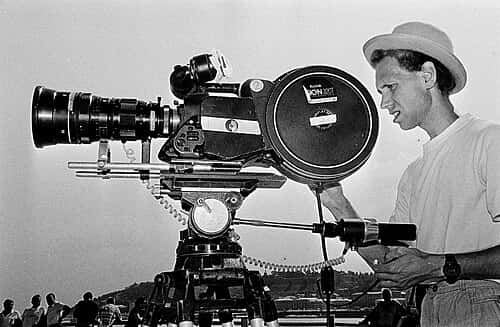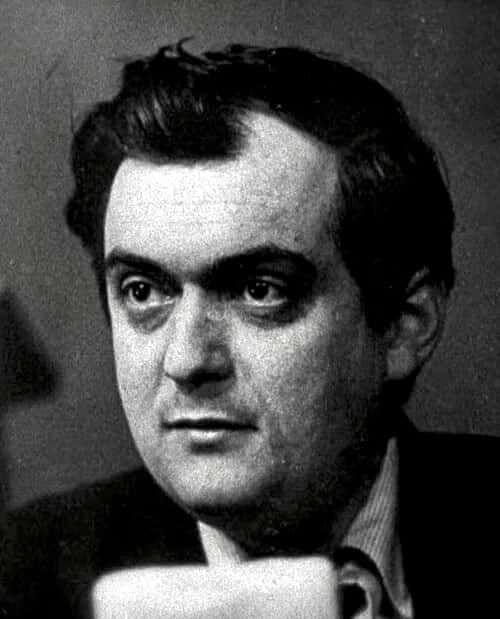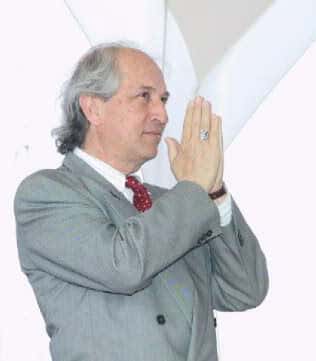
Vittorio Storaro is the son of a film projectionist at Lux Film Studios in Rome. He began studying photography at age 11, graduated from Italy's national film school at 20, and was shooting features by his mid-twenties. He won three Academy Awards for Best Cinematography, for Apocalypse Now (1979), Reds (1981), and The Last Emperor (1987). His work with Bernardo Bertolucci on The Conformist (1970) and Last Tango in Paris (1972) helped define the visual language of 1970s art cinema. He developed the Univisium 2:1 aspect ratio format in 1998, collaborated with Rosco on a signature line of color gels called the Storaro Selection, and authored the multi-volume series "Writing with Light."
Product description
The Arriflex 35 BL (Blimped Lightweight), introduced in 1972, was the first self-blimped 35mm motion picture camera quiet enough for sync-sound shooting without an external housing. Its mirror-reflex viewfinder and rugged construction made it a standard tool in European and independent filmmaking from the 1970s onward.
Connection note
Mitchell
Product description
The Mitchell BNCR is a blimped, studio 35mm motion picture camera introduced in 1967 as a reflex-viewing upgrade to the original Mitchell BNC (1934). The "R" designates the addition of a spinning mirror reflex viewfinder, allowing operators to see through the lens while filming. Its double-claw, register-pin movement provided exceptional image steadiness, and the aluminum blimp housing made it near-silent on sound stages. The BNCR dominated Hollywood studio production through the 1970s.
Know something Vittorio Storaro uses that's not listed?
Log in to submitLast updated March 20, 2026
Connection note
ARRI
Product description
Released in 1993 as a lighter, more compact redesign of the original ARRIFLEX 535. It is a 35mm sync-sound production camera with PL mount, crystal-controlled speeds from 3 to 60 fps, and a mechanical variable shutter adjustable from 11 to 180 degrees. Supports Super 35 format and SMPTE time code. It was replaced by the Arricam ST and LT in 2000.
Connection note
Product description
Sony's flagship 8K digital cinema camera, built around a single 20-megapixel Super 35mm CMOS sensor capable of capturing 8K (7680x4320) raw output. It uses a rotary shutter rather than an electronic one. Introduced in 2011.
Connection note
Cooke
Product description
Cinema prime lenses with the warm, slightly soft "Cooke Look" that flatters skin tones and organic textures.
Connection note
Bausch & Lomb
Product description
Bausch & Lomb produced several lines of cinema primes from the 1930s through the 1970s, including the Baltar, Super Baltar, and Ultra Baltar series. These single-coated lenses became Hollywood standards, known for warm rendering, smooth bokeh, and veiling glare that softens digital imagery.
Connection note
Product description
A set of 10 deeply saturated color filter gels co-developed by cinematographer Vittorio Storaro and Rosco after production on Dick Tracy (1990). Created because Storaro found existing gels too weak, requiring multiple layers to reach the saturation he wanted. Part of the Rosco Cinegel range.
Connection note
Technovision
Product description
Anamorphic cinema lenses originally developed by Henryk Chroscicki's Technovision company in Rome, combining Japanese Shiga anamorphic elements with Cooke Speed Panchro or Zeiss base optics. Used by Vittorio Storaro on Apocalypse Now and Suspiria.
Connection note

Federico Fellini