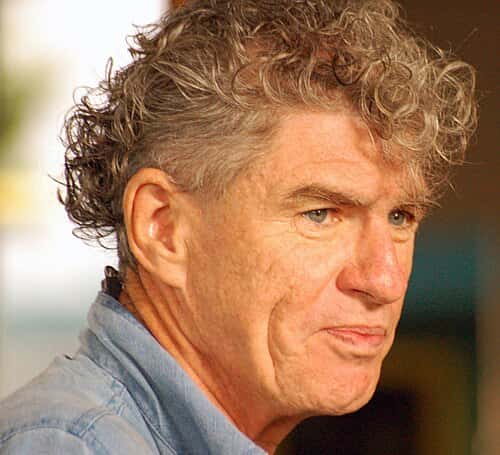
Christopher Doyle was born in Sydney in 1952, left Australia at eighteen on a Norwegian merchant ship, and drifted through odd jobs across Asia before landing in Taiwan. His first filmmaking experience was a 20-day documentary on Hakka music shot on Kodachrome 40 Super 8. He became a key figure in Taiwan's New Cinema movement in the early 1980s, then began his defining collaboration with Wong Kar-wai on Days of Being Wild (1991), going on to shoot Chungking Express, Fallen Angels, Happy Together, In the Mood for Love, and 2046. His work has also appeared in Zhang Yimou's Hero, Gus Van Sant's Paranoid Park, and films by Jim Jarmusch and M. Night Shyamalan.
ARRI
Product description
ARRI's 35mm sync-sound production camera introduced in 1990 as a replacement for the Arriflex 35 BL line. Featured a programmable mirror shutter that could vary its open angle while running, enabling exposure-compensated speed ramps. Earned ARRI a Scientific and Engineering Academy Award in 1995.
Connection note
Panavision
Product description
Updated version of the Panaflex Gold, a 35mm motion picture camera in Panavision's rental-only system. Features improved electronics and movement over the original Gold, with crystal-controlled speed regulation and a 200-degree shutter. Widely used in Hollywood through the 1990s and 2000s.
Connection note
Know something Christopher Doyle uses that's not listed?
Log in to submitLast updated March 20, 2026
Kinoptik
Product description
Ultra-wide rectilinear cinema prime made by French manufacturer Kinoptik starting in the mid-1960s. At 9.8mm with a T2.3 aperture, it was the widest rectilinear lens for 35mm film until the Zeiss Ultra Prime 8R.
Connection note
Angenieux
Product description
Wide-angle cinema zoom from the Angenieux Optimo line with T2.6 aperture, 114mm front diameter, and minimum focus of 2 feet. Weighs 4.2 pounds, making it one of the lighter professional cinema zooms. Covers Super 35 format.
Connection note
Panavision
Product description
Panavision's C Series 2x anamorphic primes have been in continuous use since their introduction in 1968. Available in focal lengths from 35mm to 100mm, they are compact and lightweight, making them well suited for handheld and Steadicam work. The lenses produce a pronounced anamorphic flare and organic bokeh with graduated depth of field.
Connection note
Product description
Tungsten-balanced color negative rated at EI 500, introduced in 1996 as part of Kodak's first-generation Vision line. Provided fine grain for its speed class along with clean highlights and natural flesh tones. Widely used in 1990s and early 2000s productions.
Connection note
ARRI
Product description
The Arriflex 35 BL4, the final model in ARRI's blimped 35mm camera line, features a chrome nickel steel PL mount and a variable speed range of 5 to 36 fps. Production of the BL4S variant ended in 1990 after over 1,700 total BL-series units were built. It was succeeded by the Arriflex 535.
Connection note
Robbie Ryan