Fernando Frazão/Agência Brasil
Sebastião Salgado trained as an economist before taking up photography in his late twenties, producing long-term documentary projects that have spanned decades and continents. His Workers (1993) and Migrations (2000) documented labor and displacement at a scale few photographers have attempted. In parallel with his photographic work, he and his wife Lélia have replanted more than two million trees on degraded land in Brazil through the Instituto Terra.
Connection note
Product description
The M6, produced from 1984 to 1998, was the first M-series Leica to include a through-the-lens exposure meter. It retained the mechanical shutter and M bayonet mount of earlier cameras, maintaining full compatibility with decades of Leica M lenses.
Know something Sebastião Salgado uses that's not listed?
Log in to submitLast updated June 9, 2026
Connection note
Product description
In production since 1954, Tri-X 400 is a black-and-white film whose grain structure, broad exposure latitude, and response to push processing made it the dominant film in photojournalism and street photography for decades.
Connection note
Product description
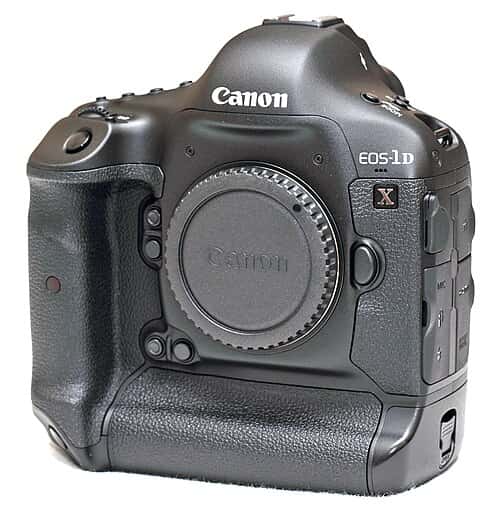
Canon's flagship full-frame DSLR, introduced in 2011. It shoots at 12 frames per second and was designed for professional use in sports, editorial, and portrait photography under demanding conditions.
Leica
Connection note
Product description
A fully mechanical 35mm film SLR produced from 1988 to 1992, featuring a non-battery-dependent shutter. Lightweight at 625g, it offers mirror lock-up, interchangeable focusing screens, and selective/integrated metering. The first mechanical, manual-exposure-only SLR from Leica since the Leicaflex SL2.
Connection note
Product description
A wide-angle prime produced in two versions for the Leica R mount, starting in 1970. The first version used an 8-element-in-8-groups design with a close focus of 30cm, while the second version, introduced in 1994, added a floating element for improved close-range performance. Roughly 50,500 units were made, including a small run in Safari green.
Connection note
Product description
A six-element macro lens produced from 1972 to 2009 for Leica's R-mount SLR system. It focuses down to 30cm for a 1:2 reproduction ratio natively, reaching 1:1 with a dedicated extension tube. The lens went through two main versions but kept the same optical formula throughout, and it earned a reputation for rendering that balanced clinical sharpness with smooth tonal transitions.
Connection note
Product description
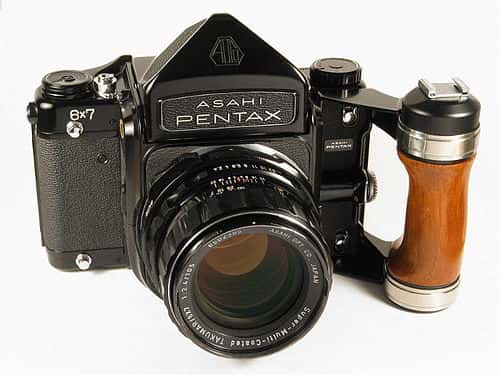
The Pentax 67 is a medium format SLR producing 6×7cm negatives on 120 film. Introduced in 1969, its SLR handling in a medium format body made it practical for handheld work requiring larger negatives than 35mm. It was widely adopted by portrait, landscape, and fashion photographers.
Canon
Connection note
Product description
Canon's ultimate professional 35mm film SLR, the EOS-1V featured a 45-point Area AF system, 10fps shooting with the Power Drive Booster, and a tank-like weather-sealed body. It was the last top-tier film body Canon produced before going all-in on digital.
Mamiya
Connection note
Product description
Introduced in 1995, the Mamiya 7 is a medium format rangefinder producing 6×7cm negatives on 120 film. Its light weight and high-resolution lenses made it a practical tool for location and travel photography requiring medium format quality.
Connection note
Product description
Canon's flagship professional DSLR from 2007, the 1Ds Mark III paired a 21.1-megapixel full-frame sensor with dual DIGIC III processors and a rugged, weather-sealed magnesium body rated for 300,000 shutter actuations. It was the studio and editorial standard-bearer of its era, prized for its color accuracy and build quality.
William Eggleston