Art is Hard
ArtistsGear
Categories
PaintingPhotographyFilmMixed Media
Log inSign up

Art is Hard

Good gear helps.

Browse

ArtistsGearCategories

Account

Log inSign upWishlist
AboutNo Ads PledgePrivacy PolicyTerms of ServiceFeedbackContact

This site contains affiliate links. We may earn a commission when you purchase through links on this site, at no extra cost to you. Learn more in our Terms of Service.

© 2026 Art Is Hard Co.

Artists

Hoyte van Hoytema

Filmmaker
Dutch-Swedish·b. 1971
Known for:
Christopher Nolan's cinematographer, champion of IMAX large-format and Kodak film
Education:
National Film School in Łódź, Poland

Hoyte van Hoytema is a Dutch-Swedish cinematographer born in Horgen, Switzerland in 1971 to Dutch parents. After being rejected twice from the Netherlands Film Academy, he studied cinematography at the National Film School in Lodz, Poland. He gained international recognition shooting Let the Right One In (2008) and has since become one of cinema's foremost advocates for large-format film, shooting on IMAX 65mm and 65mm Panavision cameras across major productions including Interstellar, Dunkirk, Tenet, Nope, and Oppenheimer. He won the Academy Award and BAFTA for Best Cinematography for Oppenheimer (2024) and runs Honeycomb Modular, a company developing custom camera and lighting equipment.

Hoyte van Hoytema's Gear List(15)

IMAX MKIII

IMAX

Product description

Large-format motion picture camera that runs 65mm film horizontally in a 15-perforation frame, producing one of the largest film negatives in cinema. Uses a vacuum system to hold film flat in the gate, which makes the camera too loud for sync-sound dialogue. Holds 1,000 feet of film for roughly three minutes of shooting at 24 fps.

Connection note

Used IMAX MKIII on Tenet and Oppenheimer
Source: Website ↗
IMAX MKIV

IMAX

Product description

Reflex-viewfinder version of the IMAX camera system, shooting 65mm film in the 15-perf horizontal format. Like all IMAX film cameras, it produces a massive negative but is noisy due to its vacuum film transport and limited to about three minutes per 1,000-foot load.

Connection note

Used IMAX MKIV Reflex Camera on Dunkirk, Tenet, and Oppenheimer
Source: Website ↗

Know something Hoyte van Hoytema uses that's not listed?

Log in to submit

Related artists

RR

Robert Richardson

Filmmaker
JK

Janusz Kamiński

Filmmaker

Last updated March 20, 2026

Logmar Magellan

Logmar

Product description

Danish-designed 65mm motion picture camera built by Logmar Camera Solutions. Weighs under 12 kg in a ready-to-shoot configuration with lens, 500 feet of film, and battery. The first new 65mm film camera manufactured in 30 years, it was used on Christopher Nolan's Tenet.

Connection note

Used Logmar Magellan 65mm prototype on Tenet; discovered it at an American trade show
Source: Website ↗
IMAX MSM 9802

IMAX

Product description

The IMAX MSM 9802 is a 65mm motion picture camera shooting on 15-perforation IMAX film stock, producing the largest film negative in commercial cinema. Its images, projected on IMAX screens, achieve a resolution and immersive quality that no digital system has fully replicated.

Connection note

Used on Interstellar, Dunkirk, Tenet, and Oppenheimer
Source: Website ↗
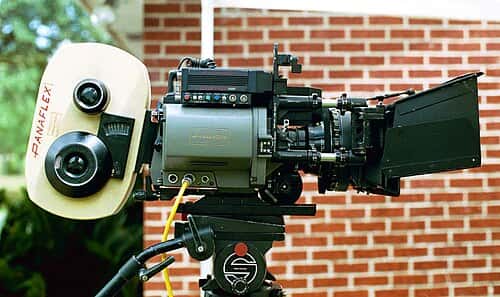
Panavision Panaflex System 65 Studio

Panavision

Product description

The Panaflex System 65 Studio is a self-blimped 65mm film camera introduced by Panavision in 1991, designed as the large-format counterpart to the 35mm Panaflex. It uses a 5-perforation pulldown on 65mm film and accepts top- or rear-mounted 400-foot and 1000-foot magazines. Compatible with all Panavision 65mm lenses and accessories.

Connection note

Quieter than IMAX cameras, used for dialogue scenes on Dunkirk, Tenet, and Oppenheimer
Source: Website ↗
ARRIFLEX 765

ARRI

Product description

ARRI's 65mm/5-perf motion picture camera, released in 1989 after six years of development. At under 25 dB(A) at 24 fps, it was dramatically quieter than other 65mm cameras of the era, making sync-sound 65mm shooting practical. Supports 2 to 100 fps with forward and reverse capability, and takes 500-foot or 1000-foot magazines. Earned a Scientific and Engineering Academy Award in 1993.

Connection note

Used on Tenet
Source: Website ↗
ARRI ALEXA 65

ARRI

Product description

Large-format 65mm digital cinema camera with a 54.12 x 25.59mm sensor, available exclusively through ARRI Rental. Used on Rogue One, Dune: Part Two, and Solo.

Connection note

Used on Spectre (2015)
Source: Website ↗
ARRI ALEXA Studio

ARRI

Product description

First ALEXA variant with an optical viewfinder, designed to bridge digital capture with a traditional film camera workflow. Used on Skyfall and Prisoners.

Connection note

Used on Her (2013), shot digitally
Source: Website ↗
ARRIFLEX 535 B

ARRI

Product description

Released in 1993 as a lighter, more compact redesign of the original ARRIFLEX 535. It is a 35mm sync-sound production camera with PL mount, crystal-controlled speeds from 3 to 60 fps, and a mechanical variable shutter adjustable from 11 to 180 degrees. Supports Super 35 format and SMPTE time code. It was replaced by the Arricam ST and LT in 2000.

Connection note

Used on Let the Right One In (2008)
Source: Website ↗
Panavision Sphero 65 Lenses

Panavision

Product description

Spherical prime lenses designed for Panavision's 65mm large-format camera system. Engineered to cover the full 5-perf 65mm negative with high resolution and even illumination across the frame.

Connection note

Custom-tuned by Dan Sasaki. Used on Dunkirk, Tenet, Oppenheimer, and Nope
Source: Website ↗
Hasselblad Lenses (medium format)

Hasselblad

Product description

Carl Zeiss-designed lenses for the Hasselblad V system, covering the 6x6cm medium format frame. Produced across several generations including C, C T*, and CF series, with focal lengths from 30mm to 500mm. The CF lenses feature Prontor leaf shutters with speeds up to 1/500s.

Connection note

Called "micro-macro" lenses with 1:1 magnification. Used on Interstellar, Dunkirk, Tenet, Oppenheimer
Source: Website ↗
Zeiss Super Speed Lenses

Zeiss

Product description

Fast cinema prime lenses (T1.3) originally designed for low-light 35mm film production, with a warm, organic rendering.

Connection note

Used on Let the Right One In (2008)
Source: Website ↗
Kodak Vision3 250D 5207

Kodak

Product description

Kodak Vision3 250D 5207 is a medium-speed daylight-balanced (5500K) color negative motion picture film rated at ISO 250. Introduced in 2009 as the second stock in the Vision3 family, it shares the same Dye Layering Technology as the 500T, with low measured granularity and extended highlight latitude. Processed in ECN-2 chemistry.

Connection note

Primary daylight stock. Used on Interstellar, Dunkirk, Spectre, Tenet, Nope, Oppenheimer
Source: Website ↗
Kodak Vision3 500T 5219

Kodak

Product description

Kodak Vision3 500T 5219 is a high-speed tungsten-balanced (3200K) color negative motion picture film rated at ISO 500. Introduced in 2007 as the first stock in Kodak's Vision3 line, it uses Dye Layering Technology to reduce grain in shadows while maintaining a wide exposure latitude. Available in 35mm and 16mm (7219), it is processed in ECN-2 chemistry and remains a standard for low-light and interior cinematography.

Connection note

Primary tungsten/low-light stock across Interstellar, Dunkirk, Spectre, Tenet, Nope, Oppenheimer
Source: Website ↗
Kodak Double-X 5222

Kodak

Product description

Eastman Double-X 5222 is a black-and-white negative motion picture film rated at EI 250 in daylight and EI 200 under tungsten light. Originally developed from Kodak's Super-XX formula and released in its current form in 1959, it has remained largely unchanged for over six decades. It was the stock used to shoot Raging Bull, Schindler's List, and Manhattan.

Connection note

Custom-manufactured by Kodak in 65mm for Oppenheimer. First-ever IMAX black-and-white film stock
Source: Website ↗
EL

Emmanuel Lubezki

Filmmaker
RR

Robbie Ryan

Filmmaker
Bradford Young

Bradford Young

Filmmaker
EL

Ed Lachman

Filmmaker