Camera

Panavision

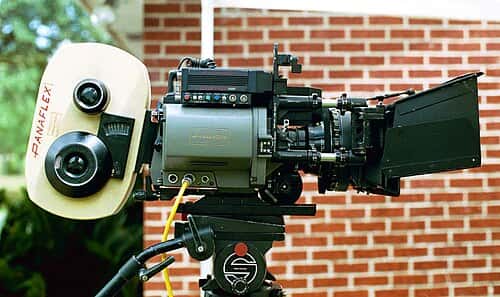
Panavision Panaflex Gold

The Panaflex Gold is a 35mm motion picture camera produced by Panavision, a company that manufactures equipment exclusively for rental to productions. Its near-silent operation and compatibility with Panavision's proprietary anamorphic and spherical lens systems made it a standard for Hollywood features from the 1980s onward. Christopher Nolan and many other directors continue to use Panavision equipment for productions shot on film.

Artists who use this(5)

Christopher Nolan

Nolan has used Panavision equipment throughout his career and is a documented advocate for shooting on film over digital; his cinematographer Hoyte van Hoytema and Panavision have discussed their collaboration on Dunkirk (2017), Interstellar (2014), and subsequent productions.

David Lean
David Lean

Lean shot "Ryan's Daughter" (1970) and "A Passage to India" (1984) using Panavision equipment; his collaboration with the cinematographer Freddie Young across three films used Panavision anamorphic lenses to achieve the widescreen landscape compositions for which his later work is known. Documented in Kevin Brownlow's "David Lean: A Biography" (1996).

Nicholas Ray

Ray was among the earliest directors to exploit CinemaScope and widescreen anamorphic composition as psychological tools rather than novelties; his films "Johnny Guitar" (1954), "Rebel Without a Cause" (1955), and "Bigger Than Life" (1956) used the wide frame to isolate figures against architecture and landscape in ways that anticipated later directors' use of Panavision. His widescreen practice is discussed in Bernard Eisenschitz's "Nicholas Ray: An American Journey" (1993).

Sam Peckinpah
Sam Peckinpah

Peckinpah shot "The Wild Bunch" (1969) using six Panavision cameras simultaneously for the film's action sequences, a scale of multi-camera operation unprecedented in Hollywood Westerns. The production's use of Panavision cameras and anamorphic lenses at varying frame rates — from 120 frames per second down to 12 — is documented in Garner Simmons's "Peckinpah: A Portrait in Montage" (1982) and in the BFI's production notes.

Michael Powell

Powell's later productions used Panavision equipment; his commitment to the formal possibilities of widescreen cinema, developed through his Technicolor work of the 1940s, continued into his subsequent projects. His use of Panavision and his thinking about anamorphic composition are discussed in "A Life in Movies" (1986), his autobiography.