Robert Bridge Richardson was born in 1955 in Hyannis, Massachusetts and grew up on Cape Cod. He studied oceanography at the University of Vermont before films by Ingmar Bergman redirected him toward cinema, leading to a BFA at Rhode Island School of Design and an MFA at the AFI Conservatory, where he interned with Nestor Almendros and Sven Nykvist. His career took off when Oliver Stone hired him for Salvador and Platoon in 1986, beginning a run of collaborations with Stone, then Martin Scorsese (Casino, The Aviator, Hugo) and Quentin Tarantino (Kill Bill, Django Unchained, The Hateful Eight, Once Upon a Time in Hollywood). He has won the Academy Award for Best Cinematography three times, for JFK (1991), The Aviator (2004), and Hugo (2011).
Panavision
Product description
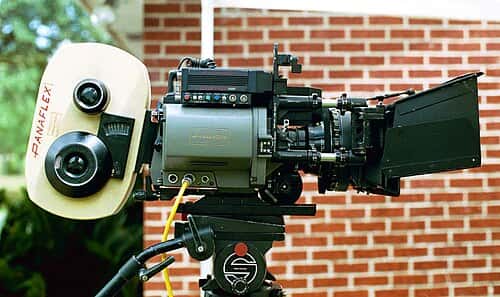
The Panaflex Millennium XL2 is a 35mm sync-sound film camera introduced by Panavision in 2004 as an update to the original Millennium XL. It features crystal-controlled speeds from 3 to 50 fps with in-shot speed ramping, a variable shutter adjustable from 11.2 to 180 degrees, dual registration pins, and dual pull-down claws. The camera converts between studio, handheld, and Steadicam configurations and is available in 3-perf or 4-perf pulldown.
Connection note
Panavision
Product description
The Panaflex Platinum is a 35mm sync-sound film camera introduced by Panavision in 1986 as a successor to the GII Golden Panaflex. It runs at 4 to 36 fps forward and reverse with crystal control, has a variable shutter adjustable from 50 to 200 degrees while running, and uses dual full-fitting registration pins for improved image steadiness. The Platinum served as Panavision's flagship 35mm camera until the Millennium replaced it in 1997.
Connection note
Know something Robert Richardson uses that's not listed?
Log in to submitLast updated March 20, 2026
Product description
The Panaflex Gold is a 35mm motion picture camera produced by Panavision, a company that manufactures equipment exclusively for rental to productions. Its near-silent operation and compatibility with Panavision's proprietary anamorphic and spherical lens systems made it a standard for Hollywood features from the 1980s onward. Christopher Nolan and many other directors continue to use Panavision equipment for productions shot on film.
Connection note
Panavision
Product description
The Panaflex System 65 Studio is a self-blimped 65mm film camera introduced by Panavision in 1991, designed as the large-format counterpart to the 35mm Panaflex. It uses a 5-perforation pulldown on 65mm film and accepts top- or rear-mounted 400-foot and 1000-foot magazines. Compatible with all Panavision 65mm lenses and accessories.
Connection note
Product description
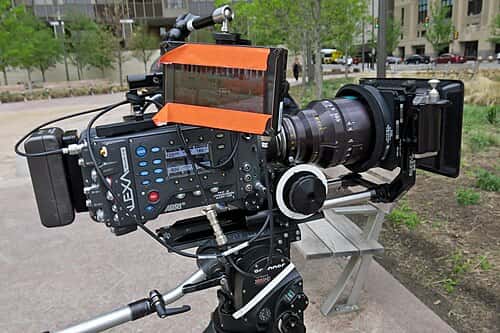
Introduced in 2010, the ARRI ALEXA is a digital cinema camera that rapidly became the industry standard for high-end film and television production. Its large-format sensor and proprietary ALEV color science produced an image quality that many cinematographers considered closer to film than any preceding digital system. It has been used to shoot Academy Award-winning films including Gravity, Birdman, and Parasite.
Connection note
ARRI
Product description
Large-format 65mm digital cinema camera with a 54.12 x 25.59mm sensor, available exclusively through ARRI Rental. Used on Rogue One, Dune: Part Two, and Solo.
Connection note
ARRI
Product description
ARRI's Super 35 format digital cinema camera, announced in June 2022. Features a 4.6K sensor (4608 x 3164) with ARRI's REVEAL Color Science, measuring 17 stops of dynamic range. Records up to 120 fps in formats including ARRIRAW and Apple ProRes.
Connection note
ARRI
Product description
The Arriflex 35 BL3 (BL-III), released in 1980, was the third generation of ARRI's blimped 35mm sync-sound camera line. It introduced the acoustically isolated PL mount, eliminating the need for separate lens blimps that earlier BL models required. It runs up to 50 fps and accepts 400 ft and 1,200 ft magazines.
Connection note
ARRI
Product description
The Arriflex 16SR, introduced in 1975, was the first truly quiet 16mm reflex camera designed for sync-sound production. It featured coaxial magazines, on-board batteries, fiber optic viewing screens, and a multidirectional viewfinder. Over 5,100 units were built across the SR, SR2, and SR3 variants before being replaced by the Arriflex 416 in 2006.
Connection note
Panavision
Product description
Ultra Panavision 70 lenses are 1.25x anamorphic primes designed for 65mm film, producing an ultra-wide 2.76:1 aspect ratio. Originally developed in the late 1950s for MGM under the name MGM Camera 65, they were used on films including Ben-Hur (1959) and It's a Mad, Mad, Mad, Mad World (1963). The format went dormant after Khartoum (1966) until Robert Richardson revived the lenses for Quentin Tarantino's The Hateful Eight (2015).
Connection note
Panavision
Product description
Panavision Primo Anamorphic primes are 2x anamorphic lenses that pair Primo spherical optics with a modified E Series cylindrical layout. Available in 35mm, 40mm, 50mm, 75mm, and 100mm focal lengths at T2, they deliver high contrast and resolution with even field illumination and minimal distortion. The lenses produce a blue anamorphic flare without excessive veiling glare and are available in both standard and close-focus versions.
Connection note
Panavision
Product description
Panavision's compact anamorphic prime lenses with a 2x squeeze factor. Smaller and lighter than the C Series anamorphics, making them practical for handheld and Steadicam work. They produce the characteristic oval bokeh and horizontal flares of front-anamorphic designs.
Connection note
Panavision
Product description
Panavision's C Series 2x anamorphic primes have been in continuous use since their introduction in 1968. Available in focal lengths from 35mm to 100mm, they are compact and lightweight, making them well suited for handheld and Steadicam work. The lenses produce a pronounced anamorphic flare and organic bokeh with graduated depth of field.
Connection note
Cooke
Product description
Cooke's fastest cinema prime series at T1.4 across all focal lengths, covering Super 35 format. Feature a seven-leaf iris, 110mm common front diameter, and Cooke /i Technology metadata contacts. Color-matched across the full range.
Connection note
Product description
Kodak Vision3 500T 5219 is a high-speed tungsten-balanced (3200K) color negative motion picture film rated at ISO 500. Introduced in 2007 as the first stock in Kodak's Vision3 line, it uses Dye Layering Technology to reduce grain in shadows while maintaining a wide exposure latitude. Available in 35mm and 16mm (7219), it is processed in ECN-2 chemistry and remains a standard for low-light and interior cinematography.
Connection note
Product description
Kodak Vision3 250D 5207 is a medium-speed daylight-balanced (5500K) color negative motion picture film rated at ISO 250. Introduced in 2009 as the second stock in the Vision3 family, it shares the same Dye Layering Technology as the 500T, with low measured granularity and extended highlight latitude. Processed in ECN-2 chemistry.
Connection note
Kodak
Product description
Eastman Double-X 5222 is a black-and-white negative motion picture film rated at EI 250 in daylight and EI 200 under tungsten light. Originally developed from Kodak's Super-XX formula and released in its current form in 1959, it has remained largely unchanged for over six decades. It was the stock used to shoot Raging Bull, Schindler's List, and Manhattan.
Connection note
Janusz Kamiński