Matthew Libatique is a Filipino-American cinematographer who met Darren Aronofsky at AFI in 1990, launching one of cinema's most enduring director-DP partnerships. Together they made Pi, Requiem for a Dream, The Wrestler, Black Swan, mother!, The Whale, and Caught Stealing, moving between 16mm, 35mm, Super 8, and digital formats depending on the demands of each story. He has also shot blockbusters like Iron Man and Iron Man 2 for Jon Favreau and prestige features for Bradley Cooper, earning Academy Award nominations for Black Swan (2010), A Star Is Born (2018), and Maestro (2023).
Bell & Howell
Product description
Spring-wound 35mm handheld camera first manufactured in 1925 by Bell & Howell. Takes an internal 100-foot film load (about one minute at 24 fps) and runs roughly 20 seconds per winding. Its small size and ruggedness made it a standard for newsreels and combat photography through World War II and Vietnam.
Connection note
Product description
Vintage Japanese 2x front-anamorphic prime lenses originally produced in the 1970s, available in 40mm, 50mm, 75mm, and 100mm focal lengths. Compact and lightweight for anamorphic glass, with 80mm front elements. Known for low contrast, warm color rendering, and easy flaring.
Connection note
Know something Matthew Libatique uses that's not listed?
Log in to submitLast updated March 20, 2026
ARRI
Product description
ARRI's Super 16mm production camera, introduced in 2006. Built with PL mount compatibility shared with ARRI's 35mm cameras, it supports frame rates from 1 to 75 fps (up to 150 fps in the HS variant) and runs below 20 dB(A) at 24 fps for sync-sound work. The viewfinder and video assist operate independently, allowing fast changeovers for Steadicam or remote operation.
Connection note
Product description
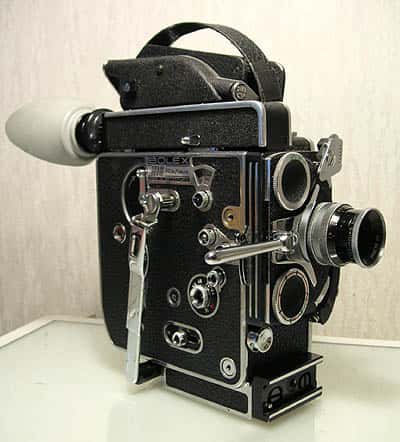
The Bolex H16 is a spring-wound 16mm film camera first produced in the 1930s and manufactured in Sainte-Croix, Switzerland for decades. Its mechanical simplicity, reliability, and optical quality made it the instrument of choice for avant-garde and experimental filmmakers. Jonas Mekas used one for decades of diary films; Stan Brakhage made most of his works with one.
Connection note
Aaton
Product description
The Aaton XTR Prod is a 16mm film camera designed to rest on the shoulder with a balance that mimics the weight of a human head, making sustained handheld operation natural. Its quiet motor and ergonomic design made it the preferred camera of documentary and New Wave filmmakers working in the 1970s and 1980s. Werner Herzog, Wim Wenders, and Agnès Varda were among its proponents.
Connection note
ARRI
Product description
ARRI's compact digital cinema camera, announced in February 2015. Uses the same ALEV III Super 35 CMOS sensor as other ALEXA cameras in a body weighing approximately 2.3 kg (5 lbs). Supports frame rates from 0.75 to 200 fps with a maximum resolution of 3424 x 2202. Succeeded by the ALEXA Mini LF and ALEXA 35.
Connection note
Product description
Anamorphic primes with Cooke's "Special Flare" single-layer coating that amplifies blue-streak flares and oval bokeh. Available in 2x squeeze for Super 35 and 1.8x squeeze for full frame, with an 11-blade iris and T2.3 maximum aperture.
Connection note
Panavision
Product description
The Panaflex Millennium XL2 is a 35mm sync-sound film camera introduced by Panavision in 2004 as an update to the original Millennium XL. It features crystal-controlled speeds from 3 to 50 fps with in-shot speed ramping, a variable shutter adjustable from 11.2 to 180 degrees, dual registration pins, and dual pull-down claws. The camera converts between studio, handheld, and Steadicam configurations and is available in 3-perf or 4-perf pulldown.
Connection note
Panavision
Product description
The PVintage series, introduced in 2013, rehouses glass elements from Panavision's Ultra Speed lenses (originally debuted in 1976) into modern barrels with a consistent 113mm front diameter. All lenses open wider than T2 and most focus down to 24 inches. The rehousing retains the soft, organic rendering of the original Ultra Speeds while standardizing size, weight, and front diameter across the set.
Connection note
Sony
Product description
The Sony Venice is a full-frame (36x24mm) digital cinema camera launched in 2017, capable of capturing up to 6K resolution. It features dual base ISO (500 and 2500), 15 stops of dynamic range, an internal 8-position optical ND filter system, and switchable imager modes for full-frame and Super 35 coverage. Succeeded by the Venice 2 in late 2021.
Connection note
Product description
Large-format digital cinema camera pairing the compact ALEXA Mini body with a full-frame sensor. First used on 1917 (2019), also used on Dune and Dune: Part Two.
Connection note
Atlas Lens Co.
Product description
Full-frame 1.5x front-anamorphic primes from Atlas Lens Co., available from 24mm to 138mm at T2.2. Feature a 14-blade iris for oval bokeh, 95mm common front diameter, and PL mount. Roughly half the size and weight of comparable 2x anamorphic lenses.
Connection note
Kodak
Product description
Eastman Double-X 5222 is a black-and-white negative motion picture film rated at EI 250 in daylight and EI 200 under tungsten light. Originally developed from Kodak's Super-XX formula and released in its current form in 1959, it has remained largely unchanged for over six decades. It was the stock used to shoot Raging Bull, Schindler's List, and Manhattan.
Connection note
Product description
Kodak Vision3 500T 5219 is a high-speed tungsten-balanced (3200K) color negative motion picture film rated at ISO 500. Introduced in 2007 as the first stock in Kodak's Vision3 line, it uses Dye Layering Technology to reduce grain in shadows while maintaining a wide exposure latitude. Available in 35mm and 16mm (7219), it is processed in ECN-2 chemistry and remains a standard for low-light and interior cinematography.
Connection note
Robert Richardson