Robbie Ryan is an Irish cinematographer born in Sandymount, Dublin, who decided at age 14 he wanted to shoot films after experimenting with his father's Kodak Super 8 camera. He studied cinematography at Dun Laoghaire Institute of Art, Design and Technology before relocating to London in 1998. He is best known for his long-running collaborations with Andrea Arnold (Fish Tank, American Honey, Bird) and Yorgos Lanthimos (The Favourite, Poor Things, Kinds of Kindness, Bugonia), and has also worked with Ken Loach, Noah Baumbach, and Stephen Frears. He received Academy Award nominations for Best Cinematography for The Favourite (2018) and Poor Things (2023), and is a member of both the BSC and ISC.
Atlas Lens Co.
Product description
2x front-anamorphic prime lenses with T2 apertures and 14-blade irises, covering a 31mm image circle for Super 35 sensors and film. Available in focal lengths from 18mm to 200mm with unified focus and iris positions across the set. Known for oval bokeh and blue streak flares.
Connection note
Product description
A 25mm anamorphic prime lens from Cooke Optics. Delivers the characteristic "Cooke Look" with warm color rendition, gentle falloff, and smooth bokeh in a 2x anamorphic squeeze.
Connection note
Know something Robbie Ryan uses that's not listed?
Log in to submitLast updated March 20, 2026
ARRI
Product description
The lightweight, handheld-optimized companion to the Arricam ST, introduced in 2000 as part of ARRI's replacement for the Arriflex 535 line. Shares the ST's dual-pin registration and dual pull-down claws but accepts only rear-mounted magazines, bringing body weight down to under 6 lbs with a 400-foot magazine. Supports 1-48 fps in 4-perf and 3-perf Super 35, with a noise level below 24 dB(A) for sync-sound shooting.
Connection note
ARRI
Product description
ARRI's flagship 35mm sync-sound studio camera, introduced in 2000 as a replacement for the Arriflex 535 line. It was ARRI's first 35mm silent camera to use displacement magazines instead of coaxial ones. Features dual-pin registration, dual pull-down claws, and an electronically adjustable mirror shutter (0-180 degrees in 0.1-degree increments) with crystal motors accurate to 1/1000 fps.
Connection note
ARRI
Product description
ARRI's Super 16mm production camera, introduced in 2006. Built with PL mount compatibility shared with ARRI's 35mm cameras, it supports frame rates from 1 to 75 fps (up to 150 fps in the HS variant) and runs below 20 dB(A) at 24 fps for sync-sound work. The viewfinder and video assist operate independently, allowing fast changeovers for Steadicam or remote operation.
Connection note
ARRI
Product description
ARRI's compact MOS 35mm film camera, released in 2003. At roughly 7.7 lbs for body and viewfinder, it weighs about half as much as the Arriflex 435, making it a standard choice for handheld work, Steadicam, and specialty rigs. Features a PL mount, manually adjustable mirror shutter (11.2-180 degrees), crystal-synced frame rates from 1 to 75 fps, and supports Super 35 format.
Connection note
Product description
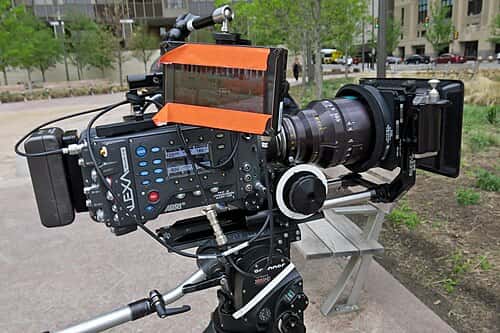
Introduced in 2010, the ARRI ALEXA is a digital cinema camera that rapidly became the industry standard for high-end film and television production. Its large-format sensor and proprietary ALEV color science produced an image quality that many cinematographers considered closer to film than any preceding digital system. It has been used to shoot Academy Award-winning films including Gravity, Birdman, and Parasite.
Connection note
ARRI
Product description
Introduced in 1963 as the final evolution of the Arriflex 35 II series, the IIC added a larger ground glass, movable viewfinder, and anamorphic desqueeze capability. It is an MOS camera with no internal electronics, powered entirely by external sources, and uses 200-foot or 400-foot magazines. Produced through 1979, it was succeeded by the Arriflex III. Over 17,000 units in the 35 II series were manufactured, making it the best-selling ARRI model line ever.
Connection note
Wilcam
Product description
The only 8-perf sync-sound VistaVision camera in existence. Its blimped body keeps motor noise low enough for dialogue recording. It has a fixed 144-degree shutter angle and was rebuilt with modern electronics, 2K video tap, and a Panavision lens mount.
Connection note
Beaumont
Product description
A VistaVision motion picture camera that runs 35mm film horizontally through an 8-perforation gate, producing a negative roughly twice the size of standard 35mm. Used on The Brutalist (2024), which earned the Oscar for Best Cinematography.
Connection note
Lomography
Product description
A modern recreation of Joseph Petzval's 1840 optical formula at 58mm f/1.9. Features a Bokeh Control Ring with seven intensity levels for adjustable swirly bokeh. Uses brass construction, Waterhouse aperture plates, and a gear-rack focusing mechanism.
Connection note
Lomography
Product description
Lomography's 85mm f/2.2 portrait lens based on Joseph Petzval's 1840 optical design. Produces signature swirly bokeh and sharp center focus with dramatic field curvature falloff. Available in brass or black brass for Canon EF and Nikon F mounts.
Connection note
Product description
The ARRI/Zeiss Ultra Prime lenses are a set of 16 cinema prime lenses ranging from 8mm to 180mm, first introduced in 1999. Most focal lengths open to T1.9, and the lenses are designed as a lighter-weight optical match to the ARRI/Zeiss Master Primes. They feature PL mounts, robust mechanical construction, and consistent color and contrast across the full set.
Connection note
Angenieux
Product description
The Angenieux Optimo 24-290mm is a 12x cinema zoom lens introduced in 2001, featuring a constant T2.8 aperture with no ramping across the full zoom range. It uses an internal focus design that maintains constant length and minimizes focus breathing, with Super 35 image coverage and a PL mount. Replaced by the Optimo Ultra 24-290mm.
Connection note
Panavision
Product description
Panavision Primo Anamorphic primes are 2x anamorphic lenses that pair Primo spherical optics with a modified E Series cylindrical layout. Available in 35mm, 40mm, 50mm, 75mm, and 100mm focal lengths at T2, they deliver high contrast and resolution with even field illumination and minimal distortion. The lenses produce a blue anamorphic flare without excessive veiling glare and are available in both standard and close-focus versions.
Connection note
Panavision
Product description
Panavision's C Series 2x anamorphic primes have been in continuous use since their introduction in 1968. Available in focal lengths from 35mm to 100mm, they are compact and lightweight, making them well suited for handheld and Steadicam work. The lenses produce a pronounced anamorphic flare and organic bokeh with graduated depth of field.
Connection note
Product description
Apochromatically corrected telephoto primes for Leica's R-mount SLR system, including 90mm f/2 ASPH and 180mm f/2 models. The APO correction eliminates color fringing across the visible spectrum. Discontinued in 2009 when Leica ended the entire R system.
Connection note
Product description
Kodak Vision3 500T 5219 is a high-speed tungsten-balanced (3200K) color negative motion picture film rated at ISO 500. Introduced in 2007 as the first stock in Kodak's Vision3 line, it uses Dye Layering Technology to reduce grain in shadows while maintaining a wide exposure latitude. Available in 35mm and 16mm (7219), it is processed in ECN-2 chemistry and remains a standard for low-light and interior cinematography.
Connection note
Product description
Kodak Ektachrome 100D 5294 is a daylight-balanced (5500K) color reversal motion picture film rated at ISO 100. It is a reformulated version of the earlier Ektachrome 100D 5285, reintroduced in 2018 after Kodak discontinued all Ektachrome products in 2013. Unlike Vision3 stocks, it is processed in E-6 chemistry rather than ECN-2, producing a positive transparency image.
Connection note
Kodak
Product description
Eastman Double-X 5222 is a black-and-white negative motion picture film rated at EI 250 in daylight and EI 200 under tungsten light. Originally developed from Kodak's Super-XX formula and released in its current form in 1959, it has remained largely unchanged for over six decades. It was the stock used to shoot Raging Bull, Schindler's List, and Manhattan.
Connection note
Product description
Kodak Vision3 250D 5207 is a medium-speed daylight-balanced (5500K) color negative motion picture film rated at ISO 250. Introduced in 2009 as the second stock in the Vision3 family, it shares the same Dye Layering Technology as the 500T, with low measured granularity and extended highlight latitude. Processed in ECN-2 chemistry.
Connection note
Product description
Kodak Vision3 50D 5203 is a low-speed daylight-balanced (5500K) color negative motion picture film rated at ISO 50. Introduced in 2011 as the finest-grain stock in the Vision3 line, it is designed for high-detail work in bright exterior conditions. Films shot on 5203 include Interstellar, Dunkirk, and Killers of the Flower Moon.
Connection note
Product description
ARRI's full-color LED soft light panel with a 645 x 300 mm aperture, producing the equivalent output of a 2000W tungsten soft light while drawing a maximum of 450W. Offers adjustable color temperature from 2,800K to 10,000K, achieving a CRI of 95 and TLCI of 90. Controllable via onboard knobs, DMX, or LAN. Replaced by the SkyPanel S60 Pro in 2024.
Connection note
Robert Richardson