Emmanuel Lubezki Morgenstern, born November 30, 1964 in Mexico City, is a Mexican cinematographer who has worked with directors Alfonso Cuaron, Alejandro Gonzalez Inarritu, and Terrence Malick. He won three consecutive Academy Awards for Best Cinematography for Gravity (2013), Birdman (2014), and The Revenant (2015), making him the only person to achieve that streak. His work is defined by natural lighting, extremely wide-angle lenses, and extended unbroken takes, often executed handheld or on Steadicam. He studied film at CUEC in Mexico City, where he first met Cuaron, and began his career in Mexican film and television in the late 1980s before moving to Hollywood productions.
Sony
Product description
Compact full-frame digital cinema camera with an 8.6K sensor delivering 16 stops of dynamic range. The first PL-mount cinema camera with in-body image stabilization. Features dual base ISO (800/3200), built-in variable ND filter, and autofocus with E-mount lenses.
Connection note
Sony
Product description
Full-frame digital cinema camera with a dual base ISO (800/3200) sensor capable of 8.6K recording. Uses an interchangeable sensor block design and supports X-OCN recording to AXS cards. Successor to the original Venice, with a smaller body and improved low-light performance.
Connection note
Know something Emmanuel Lubezki uses that's not listed?
Log in to submitLast updated March 20, 2026
Vision Research
Product description
High-speed digital camera from Vision Research capable of shooting 1080p at up to 1,000 fps and 2048x2048 at up to 555 fps. Uses CineMag flash memory cartridges for recording. Built for slow-motion cinematography in film and commercial production.
Connection note
ARRI
Product description
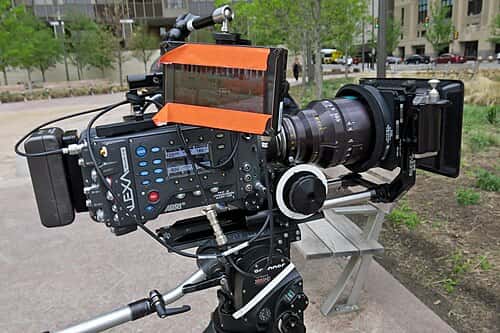
The ALEXA XT, introduced in 2013, added in-camera ARRIRAW recording via the XR Module, internal ND filtration, and a native 4:3 Super 35 sensor to the ALEXA platform. It supports ARRIRAW capture up to 120 fps onto XR Capture Drives and includes integrated CDL capture and anamorphic de-squeeze.
Connection note
ARRI
Product description
The ALEXA XT M is a split-body variant of the ALEXA XT with a compact sensor head connected to a separate processing body via fiber optic cable. Weighing under 3 kg at the head, it was designed for 3D rigs, aerial work, and confined shooting environments while retaining the same ALEV III sensor and image quality as the full-size ALEXA XT.
Connection note
ARRI
Product description
Large-format 65mm digital cinema camera with a 54.12 x 25.59mm sensor, available exclusively through ARRI Rental. Used on Rogue One, Dune: Part Two, and Solo.
Connection note
Product description
Introduced in 2010, the ARRI ALEXA is a digital cinema camera that rapidly became the industry standard for high-end film and television production. Its large-format sensor and proprietary ALEV color science produced an image quality that many cinematographers considered closer to film than any preceding digital system. It has been used to shoot Academy Award-winning films including Gravity, Birdman, and Parasite.
Connection note
ARRI
Product description
ARRI's Super 35 format digital cinema camera, announced in June 2022. Features a 4.6K sensor (4608 x 3164) with ARRI's REVEAL Color Science, measuring 17 stops of dynamic range. Records up to 120 fps in formats including ARRIRAW and Apple ProRes.
Connection note
ARRI
Product description
ARRI's 65mm/5-perf motion picture camera, released in 1989 after six years of development. At under 25 dB(A) at 24 fps, it was dramatically quieter than other 65mm cameras of the era, making sync-sound 65mm shooting practical. Supports 2 to 100 fps with forward and reverse capability, and takes 500-foot or 1000-foot magazines. Earned a Scientific and Engineering Academy Award in 1993.
Connection note
ARRI
Product description
The lightweight, handheld-optimized companion to the Arricam ST, introduced in 2000 as part of ARRI's replacement for the Arriflex 535 line. Shares the ST's dual-pin registration and dual pull-down claws but accepts only rear-mounted magazines, bringing body weight down to under 6 lbs with a 400-foot magazine. Supports 1-48 fps in 4-perf and 3-perf Super 35, with a noise level below 24 dB(A) for sync-sound shooting.
Connection note
ARRI
Product description
ARRI's flagship 35mm sync-sound studio camera, introduced in 2000 as a replacement for the Arriflex 535 line. It was ARRI's first 35mm silent camera to use displacement magazines instead of coaxial ones. Features dual-pin registration, dual pull-down claws, and an electronically adjustable mirror shutter (0-180 degrees in 0.1-degree increments) with crystal motors accurate to 1/1000 fps.
Connection note
ARRI
Product description
ARRI's compact MOS 35mm film camera, released in 2003. At roughly 7.7 lbs for body and viewfinder, it weighs about half as much as the Arriflex 435, making it a standard choice for handheld work, Steadicam, and specialty rigs. Features a PL mount, manually adjustable mirror shutter (11.2-180 degrees), crystal-synced frame rates from 1 to 75 fps, and supports Super 35 format.
Connection note
Product description
High-speed cinema prime lenses rated at T1.3 across all focal lengths (12mm to 150mm), with low distortion and consistent color rendition.
Connection note
Product description
CW Sonderoptic's cinema primes for Leica, covering 16mm to 135mm at a consistent T1.4. Average just 1.7kg per lens with a 95mm common front diameter, making them the smallest fast cinema primes available. Won an Academy Scientific and Engineering Award in 2015.
Connection note
Product description
The ARRI/Zeiss Ultra Prime lenses are a set of 16 cinema prime lenses ranging from 8mm to 180mm, first introduced in 1999. Most focal lengths open to T1.9, and the lenses are designed as a lighter-weight optical match to the ARRI/Zeiss Master Primes. They feature PL mounts, robust mechanical construction, and consistent color and contrast across the full set.
Connection note
Panavision
Product description
Variant of the Primo prime series designed for extremely short focusing distances, ranging from 14.5mm to 35mm focal length. They focus as close as 7.5 inches from the film plane, with apertures of T1.8 to T1.9.
Connection note
Product description
Low-contrast, desaturated 500-speed tungsten color negative from Kodak's Vision2 generation, produced from 2003 to 2011. Engineered for smooth flesh tones and a muted color palette. Processed in ECN-2 chemistry.
Connection note
Product description
Kodak Vision3 500T 5219 is a high-speed tungsten-balanced (3200K) color negative motion picture film rated at ISO 500. Introduced in 2007 as the first stock in Kodak's Vision3 line, it uses Dye Layering Technology to reduce grain in shadows while maintaining a wide exposure latitude. Available in 35mm and 16mm (7219), it is processed in ECN-2 chemistry and remains a standard for low-light and interior cinematography.
Connection note
Aaton
Product description
The Aaton 35-III is a compact, lightweight 35mm sync-sound motion picture camera introduced by the French manufacturer Aaton in 1989. It features a PL lens mount, 4-perf movement with Super 35 coverage, instant-change magazines, and Aatoncode timecode recorded directly onto the film edge, eliminating the need for slates. A 3-perf option was added in 2002.
Connection note
Moviecam
Product description
The Moviecam Compact is a modular 35mm motion picture camera designed by Austrian engineer Fritz Gabriel Bauer and introduced in 1990. It supports 4-perf and 3-perf pull-down with Super 35 coverage, features a microprocessor-controlled motor with crystal-accurate variable speeds, and a balanced center of gravity for handheld and Steadicam work. It received a Scientific and Engineering Academy Award in 1993. ARRI acquired Moviecam in the late 1990s and incorporated its technology into the ARRICAM line.
Connection note
Ed Lachman