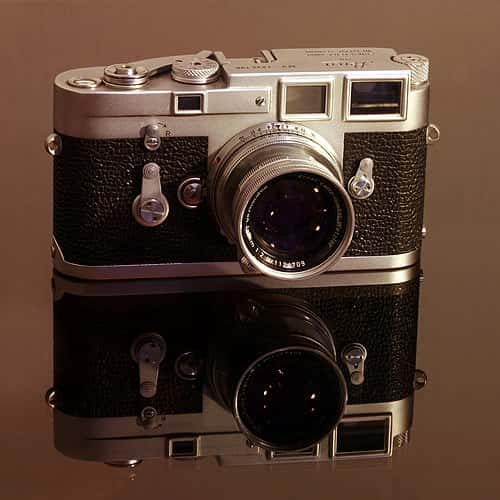
Photo by Joe Mabel
Susan Meiselas (born 1948, Baltimore) received degrees from Sarah Lawrence College and Harvard University before joining Magnum Photos in 1976, becoming a full member in 1980. Her first major project, "Carnival Strippers" (1976), documented women performing at rural New England fairs. Her second project, "Nicaragua, June 1978–July 1979," became a landmark of conflict photography and an early demonstration of color's power in documentary work. She has served as president of the Magnum Foundation since its founding in 2007 and has produced major bodies of work on Kurdistan and violence in El Salvador.
Leica
Connection note
Product description
Leica's simplified M-mount rangefinder introduced in 1957, with a 0.72x magnification viewfinder showing 35mm, 50mm, and 90mm framelines. Omits the self-timer and film counter reset of the M3, making it a lighter and more affordable body. Favored by photojournalists for decades.
Know something Susan Meiselas uses that's not listed?
Log in to submitLast updated June 9, 2026
Connection note
Product description
Introduced in 1954, the M3 was Leitz's first camera to use the M bayonet mount. Its combined viewfinder and rangefinder, with 0.91x magnification, set a standard for 35mm rangefinder design that every subsequent Leica M followed.
Leica
Connection note
Product description
Leica M-mount rangefinder introduced in 1967, combining the M2's wide framelines (35/50/90/135mm) with an angled film rewind crank and improved film loading. One of the most refined mechanical Leica bodies, produced in Wetzlar and later in Canada.
Connection note
Product description
The Summicron-M 35mm f/2 ASPH is Leica's standard fast wide-angle lens for the M system, using seven elements in five groups with one aspherical surface. First introduced in 1996 as the fifth generation of the 35mm Summicron line, it replaced the earlier all-spherical design with noticeably improved sharpness and contrast across the frame. The current version, refreshed in 2016 with a metal screw-on hood and additional aperture blades, remains in production.
Connection note
Product description
A wide-angle prime for Leica's M-mount system, first introduced in the 1960s and revised through several optical formulas. The current ASPH version uses an aspherical element in an 8-element design and weighs just 175 grams, making it the most compact lens in the M system. It focuses down to 0.7 meters and accepts 39mm screw-on filters.
Olympus
Connection note
Product description
A pioneering 35mm film SLR from 1975 that introduced automatic off-the-film metering, measuring light reflected off the film plane during exposure for remarkably accurate results. Compact and lightweight in the tradition of the OM system, it remains a favorite among film shooters for its reliability and elegant handling.
Connection note
Product description
Kodachrome 64 is a color reversal (slide) film discontinued by Kodak in 2010 after more than seven decades of production. Its dye-based structure produced colors with exceptional stability and saturation, and it was the predominant film in professional color photography for much of the postwar period.
Connection note
Product description
In production since 1954, Tri-X 400 is a black-and-white film whose grain structure, broad exposure latitude, and response to push processing made it the dominant film in photojournalism and street photography for decades.
Connection note
Product description
Velvia 50 is a color reversal film introduced by Fujifilm in 1990, rated at ISO 50. Its extremely fine grain and vivid color saturation made it the standard film among landscape and wildlife photographers through the 1990s and 2000s. It remains in production and is favored by photographers working with medium and large format cameras.
Connection note
Product description
Introduced in 2012, the 5D Mark III is a 22.3-megapixel full-frame DSLR. Its combination of resolution, 6 frames-per-second continuous shooting, and weather sealing made it one of the most widely adopted cameras among professional fashion, editorial, and documentary photographers of the 2010s.
Connection note
Product description
Canon's premier EF-mount 35mm prime, and the first lens to feature their Blue Spectrum Refractive Optics (BR) element for exceptional chromatic aberration control. A benchmark wide-angle for EF shooters that delivers outstanding sharpness and beautiful rendering wide open.
William Eggleston